
Expert Care When Your Joint Replacement Needs a Second Look
Most hip and knee replacements provide excellent pain relief and function for many years. However, sometimes problems develop that may require further treatment or surgery, called revision joint replacement.
Dr. Arshi specializes in revision hip and knee replacement, providing expert evaluation and advanced surgical care for patients experiencing pain, instability, or mechanical issues after their original joint replacement.
Why Might a Revision Be Needed?
While most joint replacements last 15 to 20 years or longer, complications can occur. Some of the most common reasons for revision surgery include:
- Prosthetic joint infection (PJI)
- Loosening or wear of the implant
- Dislocation or instability of the joint
- Fracture around the implant
- Persistent pain or stiffness
- Mechanical failure of implant components
It is important to know that not all pain or discomfort in a replaced joint means you need revision surgery. Many patients with painful prosthetic hips or knees improve with non-surgical treatments.
Comprehensive Evaluation for Painful or Unsatisfactory Joint Replacement
Dr. Arshi performs a careful preoperative evaluation to determine the cause of your symptoms and the best course of action. This includes:
- A detailed medical history and physical exam
- Standard X-rays to assess implant position and bone quality
- Advanced imaging as needed, such as CT scans, MRI, or bone scans
- Blood tests to check for infection or inflammation
- Often, a joint fluid aspiration (synovial fluid analysis) to evaluate for infection or other causes
This thorough work-up helps differentiate between issues that require surgery and those that may be managed conservatively.
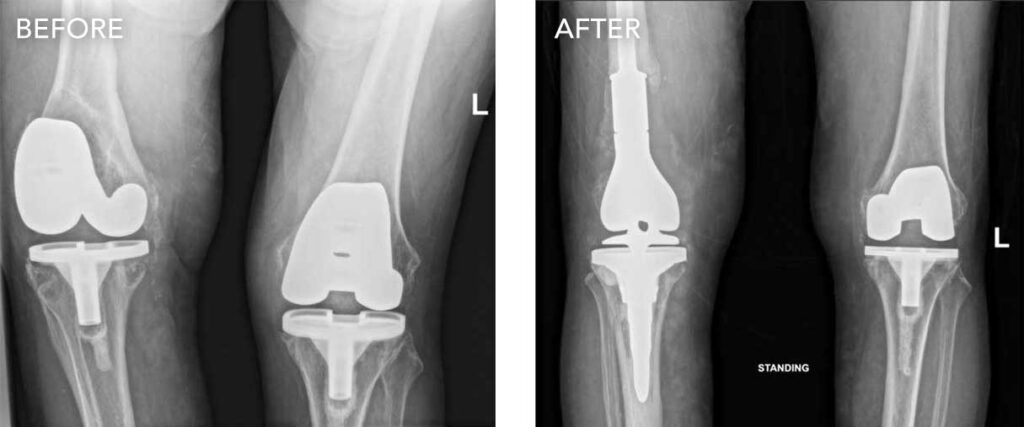
Revision to Hinged Distal Femoral Replacement for Failed Total Knee Replacement
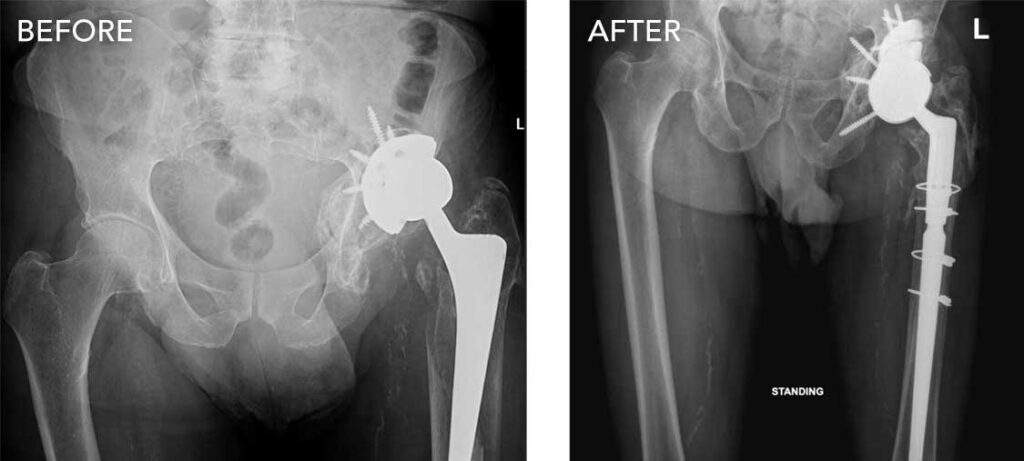
Revision Total Hip Replacement for Periprosthetic Fracture and Acetabular Bone Loss
Prosthetic Joint Infection: A Serious but Treatable Condition
One of the most challenging problems in revision surgery is prosthetic joint infection (PJI). Dr. Arshi uses the latest protocols to diagnose and treat PJI, which may include:
- Debridement, Antibiotics, and Implant Retention (DAIR): Cleaning the joint and treating infection without removing the implant, suitable for early or acute infections
- Single-stage Exchange Arthroplasty: Removing and replacing the implant in the same surgery, appropriate in select patients
- Two-stage Exchange Arthroplasty: Removing the implant and placing a temporary spacer followed by delayed reimplantation, often used for chronic infections or complex cases
The treatment plan is personalized based on your health, infection severity, and surgical goals.
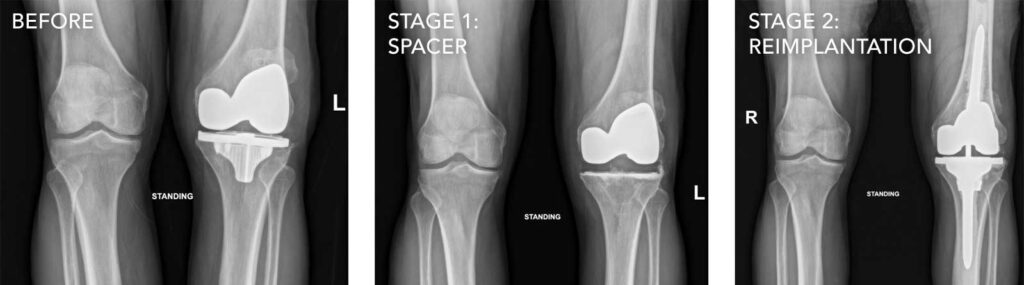
Two-stage Exchange for Infected Total Knee Replacement
What to Expect During Revision Surgery
Revision hip and knee replacements are often more complex than primary replacements. Dr. Arshi uses his fellowship training and advanced technologies—including MAKO robotic assistance and computer navigation—to maximize precision and optimize outcomes.
Some cases require custom implants or bone grafting to restore bone loss.
Recovery can take longer than primary joint replacement, but with proper care and rehabilitation, many patients regain excellent function and pain relief.
Important Reminder
Many patients experience pain or discomfort after joint replacement that does not require revision surgery. Conservative treatments such as physical therapy, medications, or injections can often help manage symptoms successfully. Surgery is considered only after careful evaluation confirms it is necessary.
Frequently Asked Questions
Revision is considered if you have persistent pain, instability, infection, or mechanical problems that do not improve with conservative treatment. Dr. Arshi will perform a thorough evaluation to determine if surgery is necessary.
Evaluation often includes X-rays, advanced imaging (CT, MRI, bone scan), blood tests to check for infection or inflammation, and joint fluid aspiration to rule out prosthetic joint infection.
Prosthetic joint infection is an infection involving the implant and surrounding tissue. Treatments range from cleaning the joint while keeping the implant (DAIR), to removing and replacing the implant in one or two stages, depending on the infection type and patient factors.
No. Many patients with pain in their prosthetic joint improve with non-surgical treatments like physical therapy, medications, or injections. Surgery is only recommended after a detailed evaluation confirms it’s necessary.
Revision surgery is often more complex due to changes in bone quality, scar tissue, or infection. Dr. Arshi uses advanced imaging, robotic assistance, and specialized implants to address these challenges safely and effectively.
Recovery times vary depending on the complexity of the surgery and individual health. It often takes longer than primary joint replacement, but with rehabilitation and follow-up, many patients regain good function and pain relief.
While the revised joint may not feel exactly like your natural joint, many patients experience significant pain relief and improved mobility. Dr. Arshi’s precision techniques aim to restore the best possible function and comfort.
Take the First Step Toward Relief
If you have pain, instability, or problems with your hip or knee replacement, don’t wait. Early evaluation by an experienced surgeon like Dr. Arshi can identify the cause and guide you toward the best treatment.